
The Value of College Has to Be Designed, Not Just Defended
If colleges claim to produce critical thinkers, ethical leaders, and adaptable graduates, they need to show where and how that formation happens.
May 18, 2026
By Dr. Mya Fisher
At a moment when families, students, employers, lawmakers, and the public are asking whether college is worth the cost, higher education has become increasingly practiced at defending itself. That pressure is not coming only from tuition bills, debt, or employment anxiety. It is also being intensified by artificial intelligence, which is forcing renewed questions about what students are learning, what kinds of judgment still matter, and what colleges provide that cannot be reduced to information access, credentialing, or automated production. Institutions point to lifetime earnings, alumni outcomes, intellectual growth, civic preparation, leadership development, social mobility, and the enduring value of the liberal arts. Many of these claims are true. But they are also often too broad to answer the question being asked.
The more urgent issue is not only whether higher education has value. It is whether colleges and universities can show where that value is intentionally produced, how students practice and develop it, and whether graduates can name what they have learned in language that matters beyond the campus. This is especially important at institutions that have long relied on the value of the credential itself. For some colleges and universities, the degree, the name, the network, and the brand have functioned as the clearest evidence of value. At highly selective institutions, there can be an implicit assumption that the institution’s reputation and alumni networks will carry graduates forward. Those things may matter. But they are not the same as formation, and they cannot substitute for a clear account of what students actually become able to do.
The value of college must be designed, not just defended. It must be intentionally created, not simply accepted because it has long been described in familiar ways.
Designing for what students become able to do
I was reminded of this recently in a conversation with my cousin, a physics professor at a small liberal arts college. She had just published an article introducing a skills-based framework for teaching physics, and as she described how that framework shaped her course design, something clicked for me. Her explanation did not reveal a problem with her approach. It revealed the limits of a more familiar model of course design, one that often treats content coverage as the center of learning and leaves the transferable skills, habits, and forms of judgment less visible. She was not simply asking what content her students needed to learn. She was asking what her course was preparing students to practice, recognize, and become able to do. What does it mean for students to understand physics not only as a body of knowledge, but as a field with methods, habits, values, and forms of professional participation?
I am not a physicist, and I am not a faculty member. But I have spent much of my career designing and redesigning fellowships, scholarships, selection processes, and diverse student learning experiences including programs, conferences and courses. In those spaces, the central questions sound different, but they are related. What is this experience designed to cultivate? What kinds of students, learners, or participants does it recognize? What does it ask them to practice? What does it reward? What does it prepare them to notice, articulate, and value? What forms of readiness, growth, or capacity does it make visible, and what forms does it overlook?
That conversation with my cousin helped clarify something I have been circling around for some time: higher education’s value crisis is not only a communications problem. It is a design problem. Colleges and universities cannot simply say they produce critical thinkers, ethical leaders, global citizens, adaptable professionals, or engaged members of society. They need to show where those capacities are intentionally developed, how students practice them, how growth is recognized, and whether students leave able to understand and articulate specifically rather than generically what they have gained.
When students cannot name what college helped them build
Too often, students experience college as a sequence of requirements rather than a coherent process of formation. They choose majors, complete distributions, satisfy prerequisites, write papers, sit for exams, join organizations, apply for opportunities, and eventually graduate. Along the way, they may be shaped in powerful ways. They may learn to analyze evidence, build arguments, revise their thinking, work across difference, tolerate ambiguity, receive feedback, manage complexity, and ask better questions. But the fact that these capacities are being developed does not mean students can name them. Nor does it mean institutions have designed the experience in ways that make those capacities visible.
This matters because students are increasingly asked to explain the value of their education in practical terms. They are asked by parents, employers, graduate programs, funders, and themselves: What did this education help you build? What can you do now that you could not do before? Why was this worth the time, cost, and sacrifice?
For many students, the available answers are thin. They can name their major. They can list internships, leadership roles, study abroad experiences, thesis topics, or campus activities. They can point to a transcript or a résumé. But they may struggle to articulate the deeper capacities they developed through four years of study and participation in an academic community. That struggle is not merely a personal failing. It may reflect an institutional failure to make formation visible while it is happening.
I know this from experience. I did not fully understand what I learned through my Williams education until I went to graduate school. I knew I had received a strong liberal arts education. I knew I had read, written, researched, and debated. But I did not yet have a clear account of what that education had trained me to do. It was only later, in graduate study, that I began to recognize the connection between years of writing papers, asking questions, constructing arguments, reading critically, and learning to think sociologically. I had been trained to examine assumptions, notice patterns, ask what social arrangements made certain outcomes possible, and resist treating the visible surface as the whole story.
The education had formed me before I had language for the formation.
That realization has stayed with me because I now see many students approaching graduation with a similar sense of disorientation. Even at highly resourced, highly selective institutions, students may leave with impressive credentials while feeling strangely unmoored. They have spent four years doing the work of college, but they cannot always explain what the work has done in them. They know they have completed something significant. They may not know how to translate it. They may also lack the language to recognize how their education matters in the world beyond a narrow set of named professional paths, such as law, medicine, business, or finance.
 Describing college by formation, not just by topic
This is one reason a skills-based approach to disciplinary learning is so compelling. If departments across an institution could articulate not only the content students encounter, but the skills, habits, and forms of judgment their courses of study cultivate, students might be able to make more intentional choices from the beginning. Instead of choosing a major primarily because it sounds interesting, prestigious, familiar, or employable, students could also ask: What capacities will this course of study help me build? What kinds of problems will it prepare me to approach? What will I practice doing repeatedly? What forms of evidence, interpretation, communication, or analysis will I learn to handle?
This would not reduce college to job training. In fact, it could offer a more serious defense of liberal education than the familiar refrain that the liberal arts teach “critical thinking.” That phrase may be true, but it has become so broad that it often fails to persuade. It has come to lose specificity. Students and families need more than a slogan. They need concrete accounts of what different forms of study actually cultivate.
A sociology major, for example, is not simply studying society. At its best, sociology develops structural analysis, pattern recognition, evidence-based argumentation, attention to context, and the ability to see how institutions, histories, incentives, and social categories shape individual lives. A physics major is not simply studying equations or natural laws. It may develop modeling, abstraction, problem decomposition, experimental reasoning, persistence through uncertainty, and technical communication. An English major is not simply reading literature. It may cultivate close reading, interpretive judgment, narrative analysis, persuasive writing, and an ear for ambiguity, audience, and meaning.
These are not minor distinctions. They are the difference between describing college by topic and describing college by formation.
A practical answer to a practical question
I heard one of the clearest examples of this kind of translation at an accepted students day at St. John’s College last spring. During an alumni panel, a parent asked the practical question many parents carry, whether or not they say it aloud: What does a student get from a degree in Classics? How does that help someone get a job?
The answer came from an alumnus who was by then a practicing attorney. He did not defend the curriculum by invoking tradition, prestige, or vague claims about intellectual enrichment. Instead, he described the process. Learning Greek, he explained, required him to confront a language he did not already understand, break it apart, examine its structure, and slowly reassemble meaning. The point was not simply that he had learned Greek. The point was that he had developed a disciplined way of approaching something initially incomprehensible and working toward understanding. The process became an applied and replicable practice in many aspects of his life, personally and professionally.
That answer stayed with me because it took a curriculum that might appear impractical from the outside and translated it into a transferable capacity. The classics were not being sold as secret vocational training. Rather, the alumnus made clear that the curriculum had given him repeated practice in a process he could use elsewhere: facing the unfamiliar, slowing down, analyzing structure, testing meaning, and building comprehension where none initially existed.
That is a powerful answer to the question of value. It is also the kind of answer higher education needs more of.
The question “How does this help my child get a job?” should not be treated as an enemy of liberal education. Often it is a practical version of a deeper question: What will my child become able to do after this experience that they could not do before? Higher education does not have to collapse itself into workforce training in order to answer that question well. But it does have to answer it with greater clarity and honesty.
 When institutional promises need institutional proof
That clarity requires institutions to look beyond communications and branding. A college cannot solve its value problem merely by improving its website copy, sharpening its admissions materials, or telling better alumni stories. Those may help, but they are not enough. The deeper issue is whether the institution’s programs, courses, advising structures, assessments, and opportunities are actually aligned with the kinds of students it claims to produce.
This is also where institutions have to be more honest about the distance between aspiration and production. Colleges often describe themselves through their ideals: open inquiry, rigorous debate, civic preparation, ethical leadership, intellectual courage, global citizenship, belonging, or the pursuit of truth. But an institutional promise is not the same as institutional proof. The relevant question is not only what a college says it values, but what its structures make more likely. What kinds of speech, disagreement, curiosity, caution, ambition, conformity, risk, or participation does the institution actually reward? What does it make costly? What does it leave underdeveloped?
This matters in current debates about higher education’s political and cultural climate as well. Claims that institutions are too liberal, hostile to conservative viewpoints, insufficiently inclusive, or unable to sustain genuine disagreement are often argued at the level of accusation and counter-accusation. But beneath those debates is a design question. If an institution says it prepares students for democratic life, intellectual humility, and serious engagement across difference, where are those capacities practiced? Where do students learn to disagree without caricature? Where do they encounter ideas they do not already hold and receive guidance in how to examine them seriously? Where are faculty, staff, and students supported in sustaining open inquiry without reducing every disagreement to harm, performance, or tribal sorting?
The point is not that every criticism of higher education is accurate or that institutions should define their educational purpose through political pressure. The point is that institutional claims have to be examined against institutional practice. If a college says it forms students who can think rigorously, engage difference, and participate responsibly in a plural society, then its design should make those capacities visible.
If a college says it produces critical thinkers, where are students taught to evaluate competing claims? Where do they practice distinguishing evidence from assertion? Where do they receive feedback on the quality of their reasoning? If an institution says it forms ethical leaders, where do students practice making decisions under constraint, with real attention to power, consequence, and responsibility? If a university says it prepares global citizens, where do students learn to understand language, history, context, inequality, and positionality rather than merely accumulate international experiences? If a program claims to cultivate adaptability, where do students encounter ambiguity, revise assumptions, recover from failure, and learn to act without perfect information?
THESE ARE ALL DESIGN QUESTIONS.
They ask institutions to move beyond the language of aspiration and examine the actual conditions through which students learn. They also make clear why the value of college cannot rest on reputation, tradition, or stated intention alone. If institutions want to claim formation as part of their value, they must be willing to examine whether their structures are producing the formation they promise.
Design beyond the classroom
These questions apply beyond the classroom. Fellowships, scholarships, advising systems, selection processes, internships, honors programs, and co-curricular experiences also produce lessons about what an institution values. They teach students what counts as merit, readiness, promise, leadership, and fit. They can reward polish over purpose, confidence over reflection, prestige over preparation, and insider knowledge over growth potential. Or they can be designed to recognize a fuller range of capacities and to help students understand what they are being asked to demonstrate.
In fellowship and scholarship design, this distinction matters enormously. Selection processes are often treated as neutral mechanisms for distributing opportunity. But they are never only that. They are pedagogical structures Traditional competitions often rely on familiar evidence of past performance: grades, test scores, recommendations, prior achievements, and institutional markers that are assumed to predict future success. Those measures can tell us something, but they do not tell us everything. A better-designed process can ask a different set of questions: Is this opportunity a strong fit for this student at this moment? What preparation do they bring? What purpose animates their plans? What kind of growth could this experience make possible? The questions we ask on an application tell students what kind of story matters. The criteria we use tell them what kinds of readiness, potential/promise, and fit we are prepared to recognize. The feedback we give, or fail to give, shapes how they understand preparation, growth, and possibility.
When these processes are designed poorly, they can reward students who already know how to perform opportunity. When they are designed well, they can help students clarify purpose, assess fit, understand timing, recognize their own growth, and connect an opportunity to a larger learning trajectory. I have seen how powerful that kind of advising and design can be. But that also exposes the institutional unevenness of the problem. If one office, program, or department helps students move closer to this kind of formation translation, what happens when many other parts of the institution do not? In that sense, selection is not separate from education. It is part of the institution’s formation work, but it cannot carry that work alone.
The same is true of curriculum. The question is not only what students read, solve, memorize, produce, or complete. The question is what they repeatedly practice. Do they practice asking stronger questions? Do they practice supporting claims with evidence? Do they practice revising their thinking? Do they practice working across disagreement? Do they practice recognizing uncertainty without being immobilized by it? Do they practice connecting knowledge to action?
Institutions often speak about these outcomes as if they happen naturally by virtue of exposure to college itself. But formation is not automatic. It is shaped by design, reinforced by practice, clarified through feedback, and strengthened when students are taught to recognize what they are learning as they learn it
 A four-part test for college value
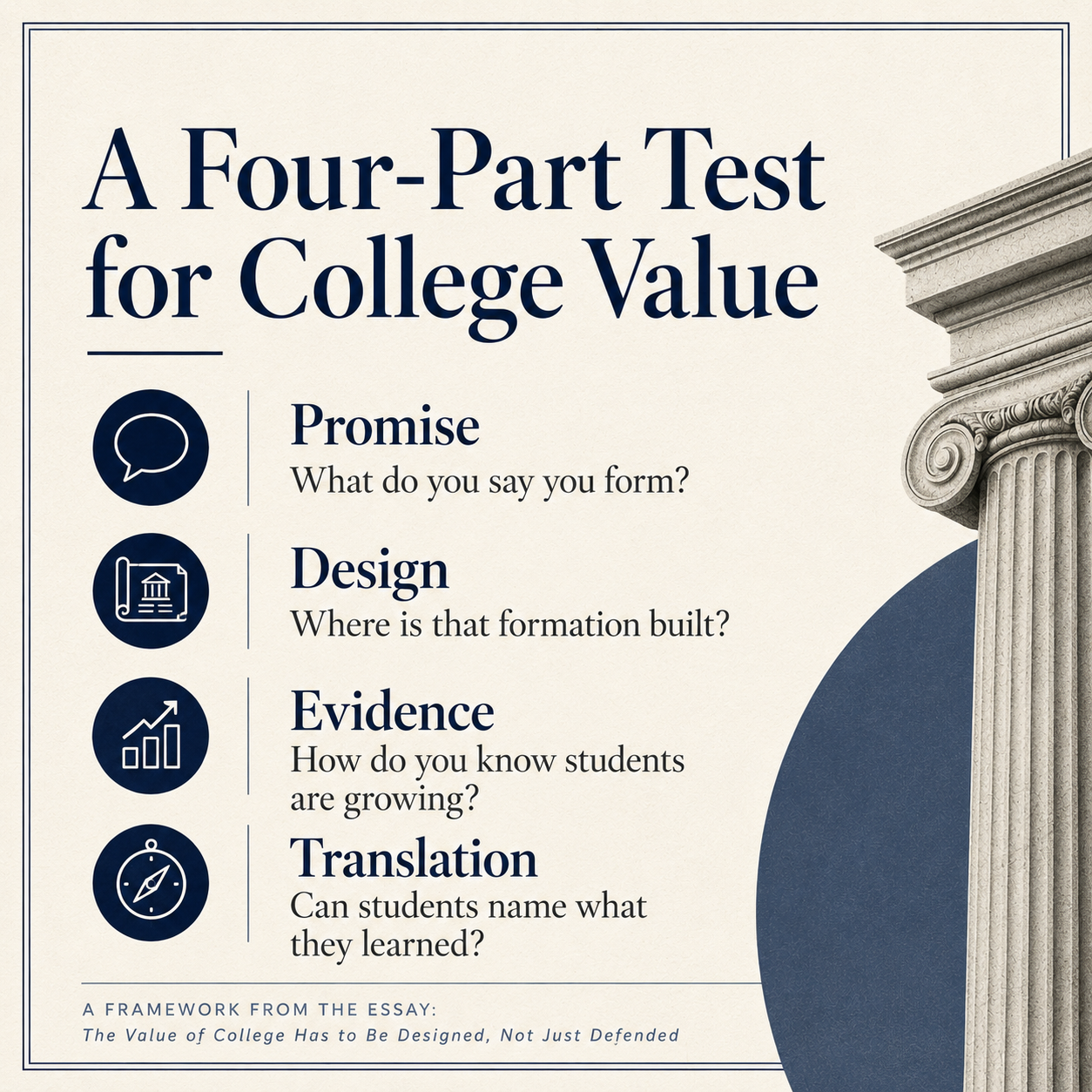
This suggests a more serious institutional test. Colleges and universities should be able to answer four questions about the value they claim to offer.
First, what is the formation promise? What kind of student, thinker, practitioner, citizen, or leader does the institution say its education helps develop?
Second, where is that promise designed into the student experience? In which courses, assignments, advising structures, selection processes, residential experiences, research opportunities, or public-facing programs do students actually practice the capacities the institution claims to value?
Third, what evidence does the institution have that students are developing those capacities? Not simply that they completed requirements or expressed satisfaction, but that they grew in discernible ways.
Fourth, can students translate that growth? Can they name what they have learned, explain how they learned it, and carry those capacities into work, community, graduate study, civic life, and relationships beyond the campus?
These questions do not require every course or program to become vocational. They do not require institutions to flatten the richness of learning into a checklist of marketable skills. They require something more demanding: alignment between promise, design, evidence, and student understanding.
Beyond the false choice between jobs and learning
For higher education, this is both a challenge and an opportunity. The public debate about college value is often framed as a contest between instrumental and intrinsic goods: job preparation versus intellectual development, return on investment versus learning for its own sake, practical outcomes versus liberal education. But that binary is insufficient to carry the actual weight of the question. A well-designed education can be intellectually serious and practically meaningful. It can cultivate habits of mind that matter in work without reducing students to workers. It can prepare students for professional life while also preparing them for citizenship, judgment, relationship, and moral responsibility.
The stronger argument for college is not that its value is too mysterious to explain. Nor is it that every form of learning must justify itself through immediate economic return. The stronger argument is that the best education changes what students can see, ask, interpret, create, endure, and do. But if that is true, institutions should be able to show how that change happens.
Students should not discover years later, by accident, what their education taught them. Families should not have to rely on faith that broad institutional promises will become real or produce a concrete return on investment. Faculty should not have to assume that students understand the transferable value of disciplinary practice simply because they completed the assignments. Employers should not be the first audience before whom students are asked to translate the meaning of their education.
That work should begin inside the institution.
Beginning the work from the inside
A skills-based physics framework, a St. John’s alumnus explaining the practical value of learning Greek, and years of fellowship and scholarship design all point toward the same conclusion: higher education does not only need better defenses. It needs better design. It needs curricula, programs, and processes that make formation intentional, visible, and assessable. It needs students to understand not only what they studied, but what they became able to do because of that study.
The question facing higher education is not only whether college is worth it. The question is whether colleges can show what they are forming, how they are forming it, and whether students leave knowing what they now carry.
If institutions want to defend the value of college, they should begin by designing that value into the experience itself. Not hiding it. Not assuming the degree, the brand, or the network can speak for itself. Making it explicit. And making it central to how students, families, faculty, and institutions understand what college is for.