

Communication
Lab
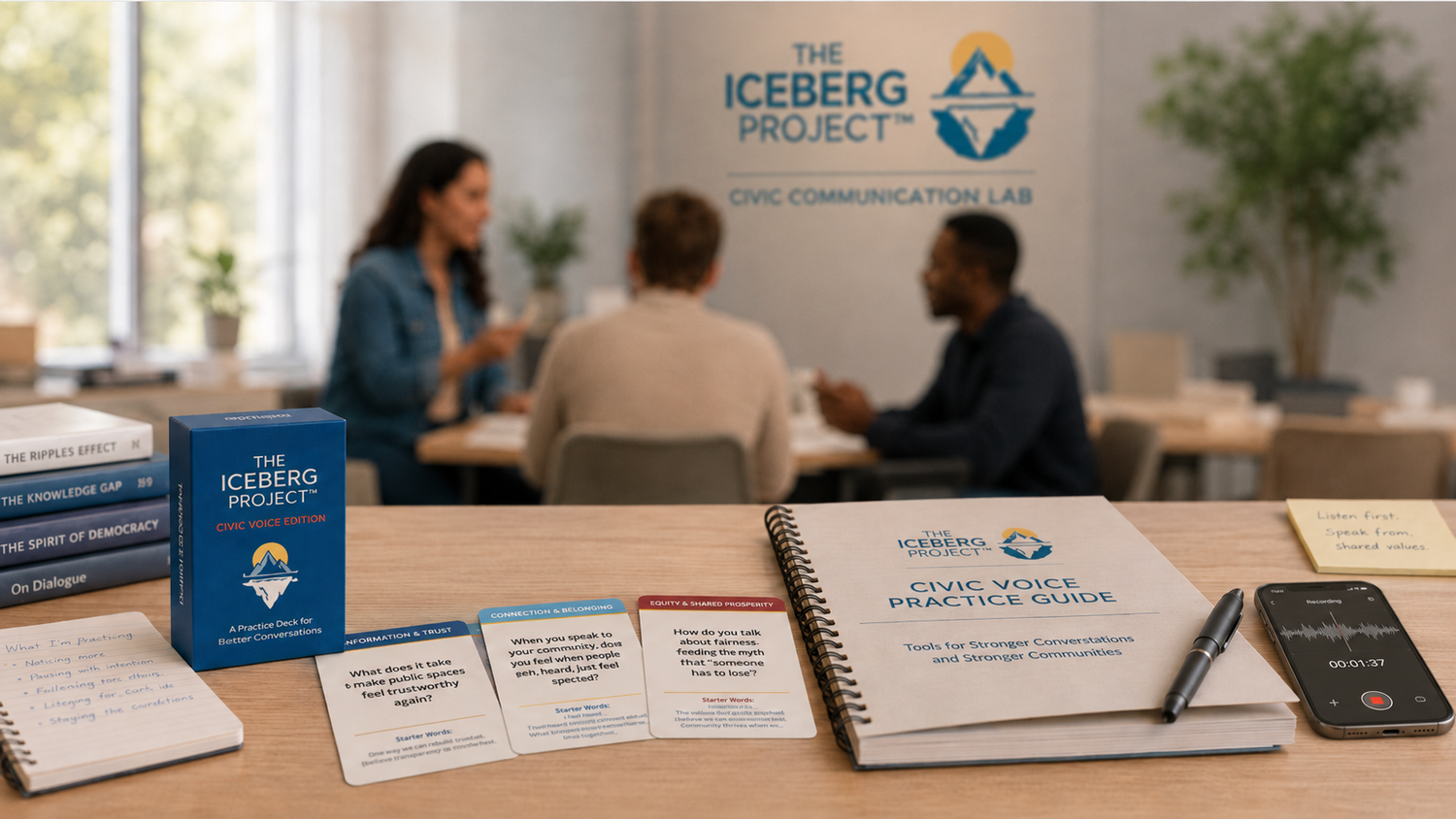
Grounded in The Iceberg Project™, the Civic Communication Lab examines what is visible in a conversation and what may be shaping it beneath the surface—assumptions, histories, pressures, incentives, trust, identity, and the work of holding complexity, staying connected, and finding ways forward that people can live with.
The Lab is designed for candidates, organizers, public leaders, and civic communicators who need a different way to talk about the things that matter—to themselves, to their communities, and to the people they hope to reach. Its work begins from a simple commitment: communication in public life should not be about conversion, but conversation.
For spring and summer 2026, the Lab opens with Civic Voice practice offerings that help participants develop their own voice with clarity, care, and intention—so the people they speak with can feel seen, heard, and engaged as participants in civic life.
what you bring into a conversation—and what others bring with them
When you step into a public conversation, you are not starting from neutral — and neither is the person in front of you.
You may be carrying:
A set of beliefs you feel responsible for representing
A need to be clear, credible, and consistent
Awareness that your words may be interpreted in different ways
Pressure to respond quickly, even when something feels unclear
The responsibility to move the conversation forward
In these moments, communication is not just about what is said—it’s about what is present, how it is interpreted, and how you choose to respond. Without a way to recognize and hold all of this, it becomes easy to react, simplify, or miss what is actually being expressed.
The person you’re speaking with is also carrying something into the moment:
Their own experiences and concerns
How your words land for them
Expectations of being heard, respected, or understood

a way to navigate what’s present in the conversation
The civic communication practice within the Civic Communication Lab begins with a simple recognition: people are not only responding to words. They are responding through experience, memory, trust, concern, identity, and hope.
That is why public communication cannot be reduced to messaging alone. It requires a way to listen for what is being expressed, understand what may be shaping it, and respond with clarity, care, and direction.
This practice equips participants to:
Recognize what is happening in the conversation and around it
Stay with what is being expressed instead of moving too quickly to respond
Make sense of what they are hearing before deciding what to say
Respond in ways that reflect understanding while still offering clarity and direction
This practice prepares the speaker not only to respond, but to listen, process, and engage in ways that allow conversations to unfold more fully. It develops the capacity to hold what is shared, make sense of what is being expressed, and respond in ways that reflect understanding while still offering clarity and direction.
This is not about memorizing talking points.
It is about developing a way of engaging in real-time conversations that is grounded, relational, and usable under pressure.
Grounded in The Iceberg Project™, this work makes visible the deeper dynamics shaping civic life and public communication. It does not guarantee agreement or positive outcomes. It creates the conditions where connection, trust, and a livable way forward become more possible.
What this changes in practice
This work does not give you better talking points. It builds a practice for noticing what is happening in a conversation, staying present to what is being expressed, and responding with clarity, care, and direction.
-

From reacting → to listening with intention
Instead of responding immediately, you begin by creating space to hear what is being shared — and what may be shaping it.
You become better able to notice not just what is said, but how it is being expressed and experienced.
-

From explaining → to processing together
Instead of moving quickly to make your point, you learn to stay with what is being expressed — making sense of it before deciding how to respond.
This allows the conversation to unfold, rather than be closed too quickly.
-

From pressure → to intentional response
Instead of reacting in the moment, you develop a way to respond that reflects what you have heard while still maintaining clarity and direction.
This creates the possibility for conversations to stay open, for people to feel understood, and for movement to happen without forcing agreement.
This is the difference between knowing what you believe — and being able to engage in conversations in ways that allow others to feel heard while still moving forward.

Where civic voice becomes practice
The Civic Communication Lab is designed for people navigating real communication challenges in public life—moments when having an opinion is not enough, and a practiced civic voice is needed.
Who this is for
Candidates, organizers, campaign staff, public leaders, community leaders, civic communicators, and organizations interested in guided practice and cohort-based learning.
When it becomes most visible
When a conversation shifts unexpectedly
When someone challenges your position directly
When trust is fragile or the room feels uncertain
When communication needs to build connection rather than performance
When you need to respond without losing clarity, dignity, or care
When difference is real, but the conversation still matters
These are moments where what is said—and how it is received—can either build connection or create distance. The Lab exists to create space for practice: developing the civic voice needed to bring clarity, protect dignity, and create movement in conversations that matter.

Work with the Lab
The Civic Communication Lab offers guided ways to begin developing a practiced civic voice — through short sessions, cohort learning, and custom group training.
Each offering creates space to practice speaking, listening, and responding with greater clarity, care, and intention in conversations that matter.
-
$50
Guided Civic Communication Session (30 minutes)
A live, facilitated session using one Civic Voice exercise to practice approaching real conversations with more clarity, care, and intention.
Best for individuals who want a focused entry point into the practice.
-
$350
Civic Communication Lab Cohort (Two-part learning experience)
A cohort-based learning experience where participants work through real scenarios and practice applying the Civic Voice approach across different contexts, roles, and experiences.
Best for participants who want to develop their civic voice in community with others.
Minimum 10 participants. Maximum 15 participants.
Partner pricing may be available with an affiliation code.
-
$5,500+
Custom Civic Communication Training
Sessions designed for a specific team, organization, region, campaign group, or cohort — focused on applying the practice directly to shared communication challenges and public-facing contexts.
Best for groups that want a tailored experience grounded in their own communication environment.
Partner pricing may be available for affiliated groups.
Choosing the right format
Cohort sessions bring together participants across contexts.
Custom sessions are designed for groups working within a shared context.
For affiliated participants
Affiliated candidates, teams, and partner groups may be eligible for special partner pricing for Civic Communication Lab cohorts or custom training.
To access partner pricing, request the appropriate affiliation code from your organization contact and include it when submitting your inquiry.
Inquire About Cohort or Custom Training
Civic Communication Lab cohorts and custom trainings are designed for people and organizations who want to develop a practiced civic voice in community. These offerings create space to work through real scenarios, strengthen communication habits, and practice speaking, listening, and responding with clarity, care, and intention.
Use this form to share what kind of session you are exploring. I’ll follow up to discuss fit, format, timing, and next steps.

the thinking behind this work
The Iceberg Project™ began with a simple observation: what we see on the surface — schools, roads, healthcare, safety, public language, and civic life — is only part of the story.
Beneath are the structures, decisions, histories, assumptions, and everyday acts of communication that shape how people experience public life.
The Civic Communication Lab extends that insight into the communication space. It focuses on how people speak, listen, and respond when trust, identity, public responsibility, and complexity are present.
At its core, this work understands communication as a shared space — where meaning is shaped not only by what is said, but by how it is heard.
Having an opinion is not the same as having a voice. A civic voice is practiced: through listening, reflection, language, care, and the willingness to stay in conversations that matter.
Every part of this work is an invitation to practice communication as a civic act.
About the creator
Dr. Mya Fisher is a sociologist, educator, and founder of Global Equity Forward. Her work brings together systems thinking, cross-cultural communication, international education, and leadership development to examine how people make meaning, build trust, and communicate across complexity.
She developed The Iceberg Project™ to make visible the connection between everyday experience and the structures, histories, and choices that shape civic life.
The Civic Communication Lab grows out of that same commitment: translating complexity into practical tools and guided experiences that strengthen how people speak, listen, and respond in public life.™ to help make visible the connection between everyday experience and the structures that shape civic life.
It is conversation.